Next time a pandemic appears we must be prepared
In 2008 Europe’s safest laboratories came together to help scientists study dangerous diseases. Their combined effort was named ERINHA.
SEC.
Our three priorities against pandemics

Connect scientists with resources
The more we study and learn now, the better prepared we’ll be to protect people in the future.
Quickly providing research projects with the resources they need is the core of our purpose.

Help humanity prepare for diseases
If a new pandemic appears, the first days are crucial.
Rapid research tools and cure development methods help us respond before a disease can spread widely.

Ensure the world works together
Shared information without borders and communication with communities play a key role in maintaining public peace of mind and ensuring informed action is taken everywhere.
SEC.
Organization snapshot
PEOPLE
12
Our internal team handles the everyday tasks and direction of ERINHA.
MEMBER ORGANIZATIONS
11
The cornerstones of ERINHA are our network of members, including advanced laboratories and other research organizations.
RESEARCH INITIATIVES
24
Most of our positive impact is generated through pooling together resources into a large project with a specific goal.
IMPACTFUL RESULTS
100+
Research fostered by us and our projects has led to over 100 results.
YEARS
16
ERINHA was initiated in 2008 and while we are proud of our history and past achievements, the present and future hold far more meaning to us.
PROFIT
0 €
We are a non-profit organization, funded by our members and donations.
SEC.
ERINHA staff












Our members
ERINHA is made possible by the work of our network members, who provide the resources we need to maintain operations.
SEC.
Organization & governance
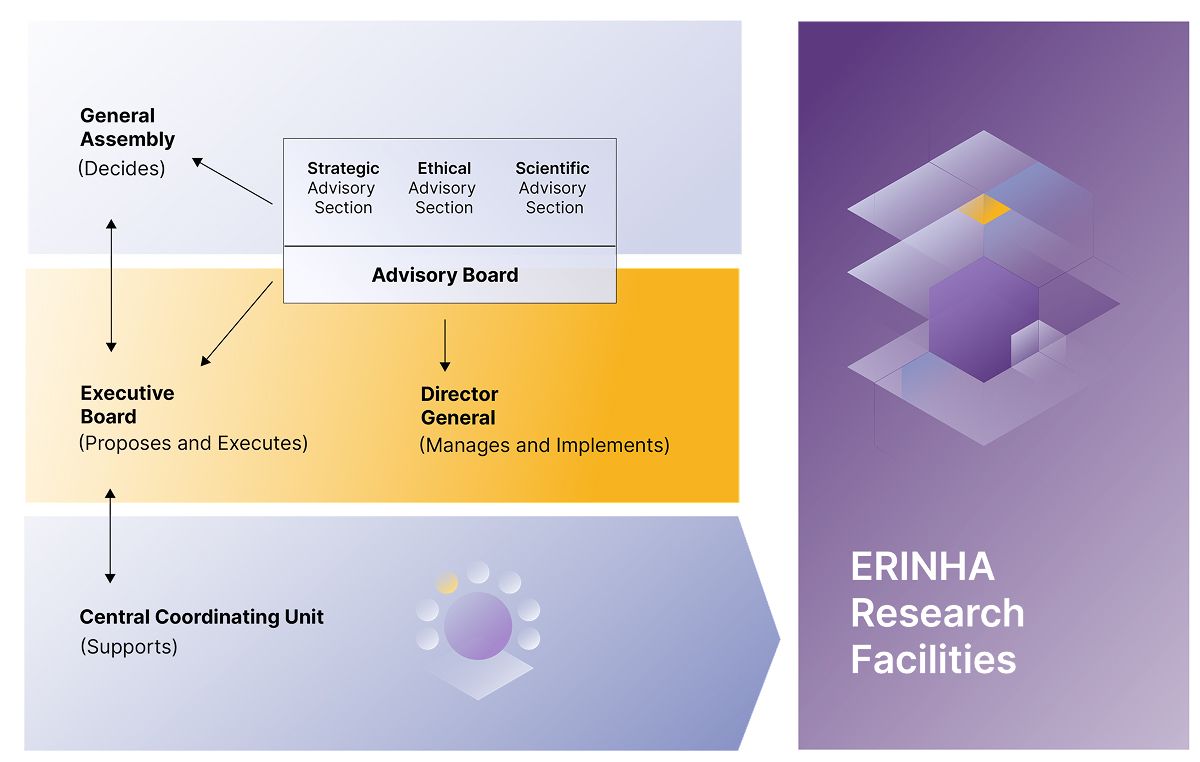
ERINHA is an international non-profit organization (AISBL) established in 2017, with offices in Brussels and Paris. Our Central Coordinating Unit (CCU) manages daily operations and ensures all work meets safety and legal requirements.
Our Structure:
- General Assembly: Main decision-making body.
- Executive Board: Manages operations.
- Director General & CCU: Handles daily management. You saw our faces in the above section.
- Advisory Board: Provides scientific, ethical, and strategic guidance.
Important Documents:
- Download the Gender Action Plan [PDF]
- Download the Non-Discrimination Plan [PDF]
- Download the ERINHA Legal statutes [PDF]
Need more details about our organization? Here’s the full list of general assembly and executive board members:
Members of general assembly
- Sofia Nuncio (National Institute of Health Doutor Ricardo Jorge, Portugal) – ERINHA General Assembly Chair
- Ron Fouchier (ERASMUS Medical Center, the Netherlands) – ERINHA General Assembly Vice-Chair
- Krisztina Biró (Ministry of Human Capacities, Hungary)
- Miles Carroll (University of Oxford, the United Kingdom)
- Maria Elena Domenech Cruz (Health Institute Carlos III, Spain)
- Robert Krause (Medical University of Graz, Austria)
- Johan Neyts (KU Leuven, Belgium)
- Hervé Raoul (National Institute of Health and Medical Research, France)
- Kevin Richards (UK Health Security Agency, the United Kingdom)
- Pietro Scanzano (National Institute of Infectious Diseases Lazzaro Spallanzani, Italy)
- Olivia Wigzell (Public Health Agency of Sweden, Sweden)
Members of executive board
- Zoltan Kis (National Public Health Institute, Hungary) – Chair of the Executive Board
- Cristina Abreu Santos (National Institute of Health Doutor Ricardo Jorge, Portugal) – Vice-Chair of the Executive Board
- Andreas Brave (Public Health Agency of Sweden, Sweden)
- Enrico Girardi (National Institute of Infectious Diseases Lazzaro Spallanzani, Italy)
- Isabel Jado Garcia (Health Institute Carlos III, Spain)
- Pieter Leyssen (KU Leuven, Belgium)
- Vincent Lotteau (National Institute of Health and Medical Research, France)
- Josianne Theuns-Van Vliet (ERASMUS Medical Center, the Netherlands)
- Kurt Zatloukal (Medical University of Graz, Austria)
ERINHA governance structure